
Napoleon's Authorization for the Sale of the Louisiana Territory
- Read more about Napoleon's Authorization for the Sale of the Louisiana Territory
- Order a Digital Image

As the United States minister to France, Chancellor Livingston was tasked with negotiating with Emperor Napoleon for the sale of the Louisiana Territory. This undertaking lasted three years. Livingston’s time in France influenced his taste in furniture, art, and design, and exposed him to technical innovations and new ventures in animal husbandry. The authorization for the sale of the territories marked a turning point in the relationship between the two nations. Livingston famously remarked: “We have lived long, but this is the noblest work of our whole lives . . . . From this day the United States take their place among the powers of the first rank."
Portrait bust

This bust of Chancellor Livingston came from the house of Dr. William Wilson (1756-1828), a neighbor in the Hudson Valley. When Dr. Wilson came to New York in 1784 from the University of Glasgow, bearing a letter of introduction to Livingston, the latter invited him to settle at Clermont. While there, Wilson became the Chancellor's intimate friend, and many years later the executor of his estate. The bust was carved out of pine and painted white to resemble marble. It was most likely produced after Livingston’s death on commission from Wilson, and may have been modeled after a portrait of the Chancellor, such as one painted by Gilbert Stuart in 1794.
Dessert knives (12) in box


Chancellor Livingston probably acquired this set of dessert knives in Paris during his diplomatic residence there from 1801 to 1804. Following European custom, dessert was served as a separate course and required distinct sets of knives and forks. Matching sets of dessert knives became stylish among wealthy Americans during the late eighteenth century. Knives such as these, with steel blades and ivory handles, were typical of those manufactured in England and France during the late eighteenth and early nineteenth centuries.
Table forks (4)


These silver table forks feature the Livingston family crest on the undersides, a demi-Hercules with a club in the left hand and a snake in the right, below a banner with the engraved motto, "Si Je Puis." This family motto refers to the Livingstons' early years in North America. Robert Livingston the Elder (1654-1728) sailed from Scotland to New York in the 1670s and was granted both a title and territory in the Hudson Valley by King George I of England. These forks may have been owned by Margaret Maria Livingston (1783-1818), daughter of the Chancellor, and her husband Robert L. Livingston (1775-1843).
Ladle


The Livingston family acquired silver in the United States and Paris. Robert R. Livingston himself owned several works made by prominent New York City silversmiths. As was the custom, the family's silver tableware, including this ladle, was marked with one of two variations of the Livingston crest. Interestly, the family used both an older Scottish motto "Si Je Puis" (If I Can) and then the subsquent "Spero Meliora" (I hope for better things). The use of heraldry distinguished the Livingston family as one of the oldest and grandest in New York.
Tailcoat


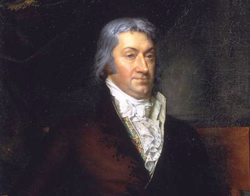
This silk tailcoat, once owned by Chancellor Livingston along with a waistcoat, is embroidered in various colors of silk in an ornate floral and leaf design. As seen in his portrait painted by John Vanderlyn, Livingston appreciated fine silk garments and enjoyed ornamental designs on his public clothes. His taste may have been indebted to French style, which he was exposed to during his time abroad in Europe.
Breeches

Robert R. Livingston may have worn these white breeches with the tailcoat (1951.519) and waistcoat (1951.520) during his political career. Elegant accents like bone and mother-of-pearl buttons reflected Livingston's taste and status as he transitioned from his title as Chancellor of New York to the United States minister to France.
Serving dish with cover

This serving dish was owned by descendants of Robert R. Livingston, Mary Read (1799-1875) and Coleman Fisher (1793-1857) of Philadelphia. The Livingston family’s appreciation for French silver extended to the acquisition of objects that emulated the style of the elegant pieces seen and purchased by the Chancellor and his children while they lived in Paris between 1801 and 1804. Produced by the premier Philadelphia silversmith Thomas Fletcher, this dish and cover reflect the early nineteenth-century consumption of American silver made for clients with distinctly French tastes.
View of Clermont, Seat of Mrs. Livingston, Tivoli, New York

Watermark: "J WHATMAN / 1794"; inscribed at lower center outside image in black ink: "Clermont the Seat of Mrs. Livingston"; at lower right outside image: "14. September 1796."
Alexander Robertson drew this view of Livingston’s estate, Clermont, when he traveled the Hudson River between Albany and New York City in 1796. The original Clermont, erected about 1730 by Lord Robert Livingston and named for the ‘clear mountain’ view of the Catskills across the Hudson River, was destroyed by the British in 1777. The home was rebuilt under the supervision of Margaret Livingston (1724-1800), the Chancellor’s mother, in 1793. At Clermont, Robert R. Livingston was free to pursue his intellectual and agricultural interests.
Pages