
Learn about AFS History
The History of the School
Curriculum
The school operated under the Lancasterian plan of education, which was designed by Joseph Lancaster in late-eighteenth-century England to provide a system for educating the lower classes.
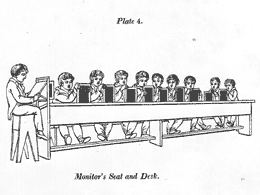
"Monitor's Seat and Desk," Plate No. 4 from Manual of the Lancasterian system, of teaching reading, writing, arithmetic, and needle-work, as practised in the schools of the Free-School Society of New-York.
New-York Historical Society
Under this system, one teacher could arguably be in charge of hundreds of students—this was accomplished through the help of monitors. Monitors were advanced students who had shown particular promise, and were charged with both instructing younger students and maintaining discipline. To encourage good behavior and good grades, instructors provided students with a series of rewards. At times, tickets were distributed. These tickets could be saved and redeemed for a trinket or might simply accrue as a reward. At other times, students were given presents directly.
As one might imagine, the Lancasterian system invested people—often no older than 14—with incredible responsibility. The records indicate that the students lived up to the charge admirably. On one occasion in 1822, a visitor to the school observes a 13-year-old boy running the entire school in the headmaster's absence:
Visited the School in the afternoon & found it in excellent order, under the superintendence of Robert Gray, Monitor of order, a boy of 13 years of age, who conducted the various exercises of the School to our admiration & entire approbations—The Teacher, C. C. Andrews, being absent for the purpose of visiting all the Parents of particularly all those children who are not regular in their attendance at School, which no doubt must have a very beneficial effect.1
One might consider the prolonged absence of a responsible adult a striking example of negligence. Certainly, it is difficult to imagine students being allowed to run a school without any supervising adults on the premises. On the other hand, one might argue that investing students with so much responsibility led them to develop keen leadership skills that would serve them well as they sought to find create and sustain a free black community in New York City.