
Learn about AFS History
The History of the School
Performing Freedom
The performances given by the students of the New York African Free School were a part of a larger social dynamic through which black New Yorkers were literally performing the role of freedom—roles that they were not sure they would be allowed to inhabit in real life. Early-nineteenth-century New York was a place of incredible change and possibility. The population was exploding—immigrants poured into the city. Historians have suggested that at this time of cultural and financial flux, no one was sure of what the boundaries could—or should—be between races and classes. For instance, although there was a good deal of racial prejudice against African Americans, there is also some evidence of alliances, or at least examples of friendly coexistence, between blacks and immigrants in the city's famous dancing halls.
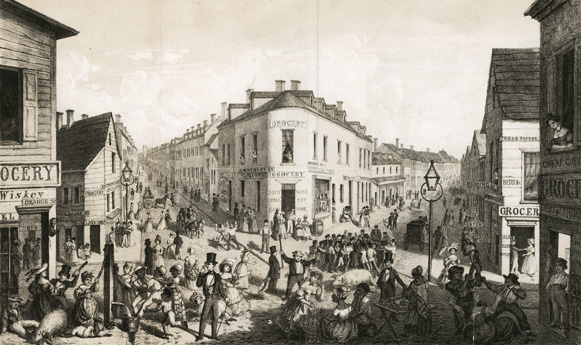
A depiction of Five Points in 1827, from Valentine's Manual (1885). African Americans and predominantly Irish immigrants faced crowding, inadequate sanitation, and the threat of disease in this impoverished neighborhood.
New-York Historical Society
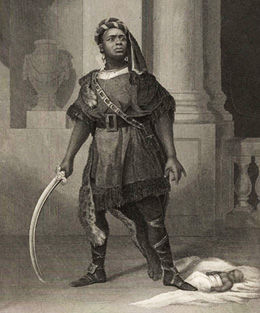
Ira Aldridge as Aaron in Shakespeare's Titus Andronicus (between 1833 and 1855).
Library of Congress, Prints and Photographs Division
In this era of seemingly unbounded possibilities the only way to know the limits of one's freedom was to test them. As historian Shane White has argued convincingly, black New Yorkers undertook the challenge of performing their freedom—acting out the role of free, equal, and confident citizens—on the streets, in the courts, and in the theaters.1 For example, the African Grove Theater delighted black audiences—and outraged white critics—by putting on productions of Shakespeare. By doing so, the theater troupe was appropriating white culture for themselves—having black actors inhabit roles reserved for the elite was a revolutionary act in itself. One of the earliest players at the Grove was Ira Aldridge, an alumnus of the New York African Free School, who would go on to be the most famous African American actor of his day.
1 See Shane White, Stories of Freedom in Black New York (Cambridge, Mass.: Harvard University Press, 2002).